 By
By A great product idea can lose momentum fast when the first manufacturing conversation gets vague. You ask about formulation, packaging, testing, and timelines, and suddenly the process feels harder than building the brand itself. That is why choosing the right small batch cosmetic manufacturing partner matters so much early on. The right fit helps you move with confidence, protect your product quality, and build a brand that is ready for repeat orders rather than a one-time launch.
For emerging beauty brands, small batch production is often the smartest starting point. It gives you room to test your concept, refine your positioning, and respond to real customer feedback without overcommitting to inventory. But small batch only works well when your manufacturer treats it with the same care, precision, and quality standards as a larger run.
What a small batch cosmetic manufacturing partner should really do
A manufacturer should do more than fill bottles. If you are developing skincare, haircare, or beauty products for your own brand, you need a partner who can translate your concept into a finished product that feels consistent, premium, and commercially viable.
That starts with formulation support. Sometimes founders arrive with a clear brief, a target texture, and a product category already mapped out. Other times, they have a strong brand vision but need help shaping the formula itself. A capable partner can work in both scenarios, guiding decisions around texture, ingredient direction, product performance, and format without making the process feel inaccessible.
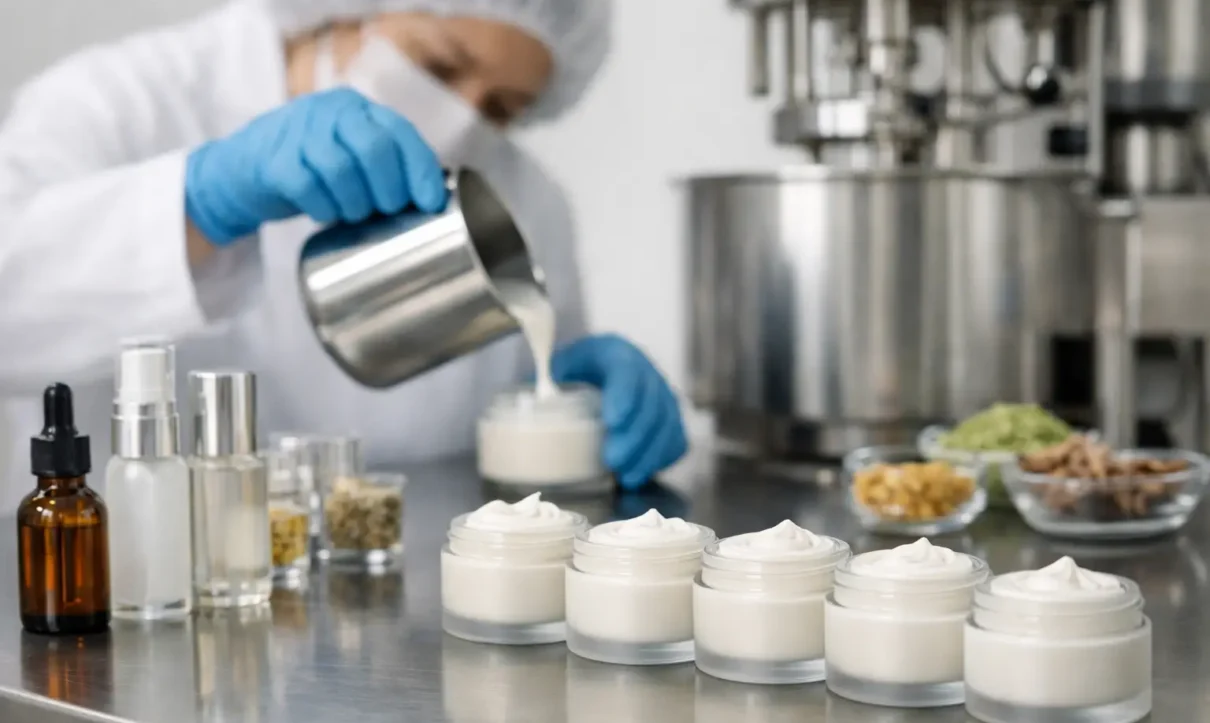
Production is only one part of the equation. Packaging compatibility, batch consistency, manufacturing controls, and quality checks all influence whether your product arrives looking and performing the way your customers expect. A polished jar and label mean very little if the fill, stability, or sensory experience changes from batch to batch.
This is where a true partner stands apart from a supplier. A supplier completes a task. A partner helps you make better decisions.
Why small batch makes sense for modern beauty brands
Small batch manufacturing is not just for brands with limited budgets. It is often the best operational choice for founders who want to launch thoughtfully.
If you are entering a crowded category, small batch production lets you test what actually resonates. Maybe your audience says they want a nourishing night cream, but the strongest demand ends up being for a lightweight daily moisturizer. Maybe your original packaging looks beautiful online but needs adjustment for shelf appeal or shipping durability. Starting smaller gives you room to learn.
It also supports a cleaner brand-building process. Instead of racing to move excess stock, you can focus on refining your offer, improving your messaging, and building demand around products that deserve a second and third run.
There is a trade-off, of course. Smaller runs can require tighter planning because you need a manufacturer that is willing to support your current stage without treating your brand like an afterthought. The best partner understands that today’s startup can become tomorrow’s scaled line – if the foundation is handled properly from the beginning.
How to evaluate a small batch cosmetic manufacturing partner
The easiest mistake is choosing based on convenience alone. Fast replies and attractive packaging options are helpful, but they are not enough. You need to know how the manufacturer works when details matter.
Look at formulation flexibility
Some brands want a private label path that gets them to market efficiently. Others want custom development that reflects a distinct brand identity. Neither route is automatically better. It depends on your timeline, budget, and positioning.
What matters is whether your partner can clearly explain the difference and recommend the best path for your goals. If every project gets pushed into the same mold, you may end up with a product that is technically finished but strategically weak.
A good manufacturing partner should be able to discuss texture, product type, and finish in practical terms. They should also be transparent about what is realistic in a small batch environment and what may require future refinement as your line grows.
Pay attention to quality control
Quality assurance should not feel like a hidden back-office function. It should be part of the conversation from the start.
Ask how consistency is maintained across batches, how products are checked during production, and how packaging and filling are handled. You are not looking for inflated promises. You are looking for evidence of discipline. Precision matters in cosmetics because customers notice the details – fill level, texture, scent profile, appearance, and overall product feel.
A premium brand experience is built in manufacturing long before it shows up in a customer review.
Assess communication style
Founders often underestimate how much project momentum depends on communication. Delays are easier to manage when expectations are clear. Product development feels smoother when feedback is specific. Packaging decisions become less stressful when someone is guiding the process rather than simply responding to it.
The right partner will be approachable, organized, and honest about timelines, revisions, and production realities. If communication feels fragmented during early discussions, it rarely improves once your project becomes more complex.
Consider scale, but do not rush it
You may be starting with a focused launch, but your manufacturer should be able to support growth when demand increases. That does not mean you need the biggest facility or the broadest service menu. It means your partner should be able to think beyond your first run and help you prepare for what comes next.
A brand that scales well usually has consistency at the core – consistent formula execution, consistent packaging standards, and consistent manufacturing processes. If those elements are weak at the small batch stage, scaling will only magnify the issues.
Red flags that deserve a second look
Not every problem appears dramatic at the start. Some of the most expensive mistakes begin as small signs of misalignment.
Be cautious if a manufacturer gives unclear answers about formulation options, avoids specifics around quality procedures, or treats your questions like obstacles. It is also worth paying attention if they seem more interested in pushing volume than understanding your brand. Small batch manufacturing should still feel intentional and collaborative.
Another common issue is mismatch in expectations. A founder may want a highly customized product with a fast turnaround and minimal development input, while the manufacturer is set up for a more standardized process. That is not necessarily anyone’s fault, but it is a sign that the partnership may not be the right fit.
The best relationships begin with clarity, not sales pressure.
What strong partnership looks like in practice
A strong small batch cosmetic manufacturing partner helps simplify decisions that can otherwise stall a launch. They bring structure to formulation development, confidence to production planning, and consistency to quality control. They understand that your product is not just a unit to manufacture – it is part of your brand story.
This matters whether you are launching your first skincare line or expanding an established range with new formats. A reliable partner can help you move from concept to finished product with fewer avoidable setbacks. That includes guiding practical decisions around packaging, helping maintain product standards, and creating a production process that supports future growth.
For many founders, the biggest relief is not just having a manufacturer. It is having a team that understands how brand-building and manufacturing need to work together.
GlowSense works with beauty brands across Australia and New Zealand that want that balance of craftsmanship, precision, and practical support. From formulation development through production and quality control, the goal is to help brands create products that feel considered from first sample to final fill.
Choosing a partner that fits your brand, not just your order size
The best manufacturing decision is rarely about finding the fastest yes. It is about finding the right fit for your product category, your standards, and the kind of brand you want to build.
A small batch launch can be a smart, strategic move when it is supported by the right systems and the right expertise. You want a partner who values premium execution at every stage, whether you are starting with one hero product or preparing for a broader collection.
If you are looking for a small batch cosmetic manufacturing partner who can help bring your brand’s vision to life with precision and care, contact GlowSense for a free quote or consultation.